The journey begins in Addis Ababa, where travelers visit the Ethiopian National Museum. The next day, they fly to Arbaminch to meet the Dorze people. In Jinka, they take a boat ride on Lake Chamo and visit Mago National Park, home to the Mursi people.
They then drive to Turmi to see the Hamar tribe and later visit the Karo and Galeb people in Omorate. After exploring Konso, a UNESCO site, they relax in Hawassa. The trip continues to Bale Mountains, where they see Ethiopian wolves and endemic animals.
Finally, they return to Addis Ababa for a farewell dinner.
Day 1: Arrival in Addis Ababa, Ethiopia
Upon arrival at the airport, you will be met by our representative, who will take you to your hotel in Addis Ababa. The capital city, Addis Ababa, is the political, cultural, and geographic center of the country. It is unique among African capitals as it has no colonial influence in its development.
One of the best attractions here is the Ethiopian National Museum, where you can see the remains of Lucy, the hominid that lived over 3 million years ago and was discovered in 1974. The city was founded by Emperor Menelik II in 1887. If you arrive early, you can take a city tour in the afternoon.
Day 2: Flight to Arbaminch
In the morning, we will take a flight to Arba Minch, a town in the southern part of Ethiopia. Upon arrival, we will drive to a village in the Guge Mountains, where the Dorze people live. These people are known for their beehive-shaped houses, which are unique because they can be moved in case of problems like termite infestations.
Day 3: Drive to Jinka
After breakfast, we will take a boat cruise on Lake Chamo, where we will look for the largest crocodiles, hippos, and water birds. After the boat ride, we will drive to Jinka, making several stops at different local community villages along the way.
If today is a Thursday, you will have a chance to see the Afar weekly market, where different tribes gather to do business.
Day 4: Jinka – Mago National Park
Early in the morning, we will drive to Mago National Park, which was gazetted in 1960. The park is home to about 300 bird species and around 100 mammals that live in its dense savannah and acacia forests.
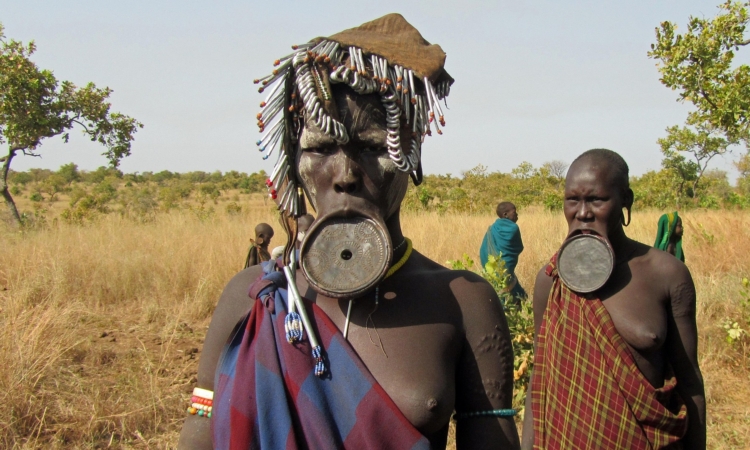
Later, we will visit a Mursi village. The Mursi people are famous for their women, who wear clay plates on their lower lips. After the village visit, we will return to Jinka for a tour of the Ethnographic Museum, which focuses on the history of the Omotic tribes. Jinka is an important center for many tribal groups in the area.
Day 5: Drive to Turmi
Today, we will drive to Turmi to visit the Hamar people. This group is known for styling their hair with clay, the women scar their bodies, and the men take part in the bull-jumping ceremony, a rite of passage before marriage. You will also meet the Benna and Ari tribes.
Day 6: Omorate Excursion
After breakfast, we will take a trip to the village of Murulle, where the Karo people live. They are a small tribe known for their body paintings, which they apply for cultural celebrations.
We will then head to Omorate to meet the Galeb people, who celebrate marriage with long feasts and fine clothing, including the tradition of slaughtering a cow. They are pastoralists and own many cattle.
Day 7: Turmi to Konso (UNESCO World Heritage Site)
Today, we will drive to the Konso area, which has been designated a UNESCO World Heritage Site. The people here live in the hills and have adapted to the environment by building terraces for farming. These terraces help them cultivate crops safely on steep slopes. This practice has lasted for about 400 years and offers spectacular views.
Day 8: Konso – Hawassa
In the morning, we will drive to the town of Hawassa, where we will relax at the resorts on the shores of the lake. This is a great place to take a break and enjoy nature. You will also have the chance to see some birds around the lake.
Day 9: Drive to Bale Mountains (UNESCO World Heritage Site)
Today, we will drive to the southeastern part of the country to visit Bale Mountains National Park, which is also a UNESCO World Heritage Site. The entrance of the park is home to many mammals, as other parts of the park are dominated by serval cats.
Here, you will also see the Mountain Nyala and Menelik’s Bushbuck, both of which are endemic to this region.
Day 10: Full Day in Bale Mountains
We will drive to the Sanetti Plateau, where there is a good chance of seeing the endangered Ethiopian wolf, which is only found in Ethiopia. Other wildlife in this area includes various rodents.
We will also stop at “Red Mountain,” also known as Tulu Dimtu, which stands at about 4,377 meters above sea level. In the afternoon, we will head to the Harenna Forest, one of the largest tropical rainforests in the country. At the base of the mountain, there is a small village called Rira, which we will explore before driving back to Robe for the night.
Day 11: Drive Back to Addis Ababa
We will leave Bale Mountains National Park and drive back to Addis Ababa. In the evening, we will have a farewell dinner with Ethiopian cuisine and entertainment from local performers.
After dinner, we will drive to the airport for your flight back home.